Showing posts with label free health education library for people. Show all posts

Sunday, July 24, 2016

Patient Safety - Book Release Function and Panel Discussion held on 19 July 2016 - Photos

  Photos of the Book Release function:
Patient Safety - Protect Yourself from Medical Errors by Dr.Aniruddha Malpani

The book release function was held at Seth GS Medical College on 19 July 2016.  The book release was followed by a panel discussion by eminent doctors.

Photos of the function:
Patient Safety - Book Release 2016

Saturday, January 3, 2015

Books at HELP: Doctor-Patient Relationship: Behind the White Coat

This week we begin a series of book reviews which will give you an insight into the collection of books at HELP.  We plan to select a few books from a different topic related to health.  We are sure you will find many books helpful to you in your journey of attaining perfect health. 

Visit us at Health Education Library for People to read or borrow these books.
Our address is:
Health Education Library for People,
Ashish, 5th Floor,
Tardeo End of Bombay Central Bridge,
Tardeo, Mumbai - 400034.
Tel Nos.65952393/ 65952394/


The doctor–patient relationship is central to the practice of healthcare and is essential for the delivery of high-quality health care in the diagnosis and treatment of disease.  We have selected some great books written by doctors based on their practice and experiences.  
 Watch this space for daily dose of healthy books !
Select books for doctors and patients you can read at   Help-logo-small.jpg
World's largest free health education library !

behind the white coat.jpg

Behind the White Coat: Intimate Reflections on Being a Doctor in Today's World


“Being a doctor is not just a combination of the ‘sublime and the ridiculous’, but primarily about compassion, love and understanding.”  So concludes Dr.Steven H.Farber at the end of the long, strange journey he details in this compelling book. The book sheds light on what it truly means to have those two mystical letters - M.D. - after your name.

“This volume should be especially appropriate for new doctors just entering the profession and for young persons considering medical school….[Also, it] is intended to dispel popular myths about physician, so that patients will have a better idea of what their doctor’s lives are really like.” - Dr.Denton Cooley
Read at HELP:  See our online catalogue

Saturday, July 5, 2014

HELP TALKS Archives: Lifestyle Related Diseases

फिर भी दिल है हिन्दुस्तानी ....says Dr.Ketan Mehta. Indians are more prone to diabetes and hypertension than people in other parts of the world.

In this video Dr.Ketan Mehta talks about Lifestyle Related Diseases.
Obesity can lead to Metabolic Syndrome and is no.1 killer in India. 
Learn about modifiable and non modifiable risk factors for heart attack.
What is diabesity ?  
What is the best way to check blood sugar levels and blood pressure ?
How much water do you require per day to remain hydrated ?
What is a Polymeal to reduce cardiovascular events by 75% ?

Answers to all these questions are found in this HELP TALK - Lifestyle Related Diseases by  Dr.Ketan Mehta.

Saturday, December 21, 2013

Find Health Information on the Internet – Using a Planned Approach


A Free Talk On Topic "Find Health Information on the Internet – Using a Planned Approach" 
By Mrs Vasumati Sriganesh  3.30 pm at HELP

About QMed


Millions of consumers search the Internet to get more information about their health. And thousands of Web sites offer all kinds of health information. Some of those sites are reliable and up-to-date; some are not. How can you learn to distinguish between the good from the bad?

In this video Mrs.Vasumathi Sriganesh, Founder QMed tells us how we can conduct clever online searches on health topics.  The talk is an introduction to a systematic process of searching for reliable information. Learning to do so, will help one to not only find and use reliable health information but also make one able to intelligently talk with one's doctor.

For more information visit www.healthlibrary.com


Saturday, September 21, 2013

Patient Advocate’s Responsibilities Towards Critically Ill Patients

Patient Advocacy
Giving Voice to Patients
Advocates can help a patient or his family make important decisions in an emotionally-charged medical scenario
In the ICU (Intensive Care Unit), treatment decisions are based not just on medical grounds or statistical probabilities. They are emotionally-charged decisions, with significant cost implications, that a patient advocate can help the patient deal with.
The clinical director of an Intensive Care Unit (ICU) once described a dilemma he faced in having to decide whether to withdraw intensive care treatment from a woman in her mid-seventies. The patient had undergone emergency surgery to repair a ruptured aorta, and subsequently developed pneumonia and renal failure. She was sedated, placed on a ventilator and treated with dialysis. Days passed during which the medical team could not agree on the next course of action - whether to withdraw the life support system and allow the woman to die peacefully, or continue the intensive care at a steep cost to the patient’s family. Was the care futile? Or did they have a chance to save her life?
Since euthanasia (mercy killing) is illegal in India, eventually a compromise was reached, which involved waiting a further 48 hours to see if continued ‘full’ treatment produced any improvement in her condition. If not, the doctors decided they would not make any aggressive efforts to save her life and would wean her off the ventilator in a careful, phased manner.
This was an emotionally charged decision – as all such “end of life” conversations can be - both for the doctor and the family. Eventually, a patient-advocate was called in, who served as a useful communication bridge between the two parties. The doctors explained the medical facts of the case to the advocate, who in turn, explained them to the family, in more simplified terms. She gave them enough time to process this information; was patient and answered all their doubts and questions; helped them to play out possible scenarios and outcomes; allowed them to negotiate with each other; and acted as a neutral referee when there were heated arguments. The family members felt comforted that their voices were being heard by the medical team and that they were participants in the decision-making process. Everyone was actively involved and they eventually reached a decision that they were all comfortable with, so she could die in peace, without meddlesome interventions. If they had been left to their own devices, without any support from an advocate, the family may not have been able to make a well-informed decision and would have been forced to passively watch their loved one suffer pain and misery while she progressively deteriorated.
When framed this way, the family did not feel guilty that they were abandoning the patient or allowing her to die, just to save their money. They realised that this was a decision they were all making, in her best interests, because the chances of her being able to lead a productive life were so slim. Such critically-ill patients can be found throughout a hospital - in emergency departments, post-anesthesia recovery units, interventional cardiology labs, pediatric and neonatal intensive care units, and burn units - and a well-trained experienced patient advocate can help both the medical team and the family to make decisions they are comfortable with.
Here’s another real life story. A man received a frantic call from his daughter-in-law, asking for help. Her husband had met with a terrible road accident. When he arrived at the hospital, he discovered that his son had several fractured ribs, bruised lungs, and a fractured skull and to make matters worse, he had serious breathing problems that required him to be quickly put on the ventilator for respiratory support. The patient was unconscious and remained in that comatose state for four long weeks.
The patient’s father, who is a friend, later confided in me that when he first laid eyes on his son, he experienced a feeling of “terror.” Tears welled in his eyes as he felt a wave of anger and impotence. As a person who always likes to remain in charge, he suddenly found himself in unfamiliar territory, frightened, clueless and helpless; trapped in a situation in which his son’s life lay in balance and all the crucial decisions related to his life were being taken by total strangers. That’s when he decided to bounce back and asked to become a part of the treatment team. He decided to appoint himself as his son’s “advocate.” Fortunately, the medical team was also receptive to this idea and was happy to have him on board. They willingly shared the responsibility for decision making with him. By assuming ownership of his son’s care plan, rather than leaving everything upto the doctors, the father helped his son to make a quick and total recovery.
Why do you need a patient-advocate for seriously-ill patients?
In reality, you need one in every unfamiliar medical situation. Self-proclaimed experts with half-baked information can strike fear in your mind when you have a medical problem. What if your fibroids are malignant? If you have gall bladder stones which aren’t troubling you, should you allow the surgeon to completely remove the organ? Is the ECG really abnormal, or is the squiggle a normal variant? Should you agree to do the stress test because of your chest pain? Or is it just heartburn, which will get better soon?
Someone has to find answers to these questions and it can be a lot better if that person is a concerned family member or a trusted friend in whose judgment you can repose complete faith. Let’s face it: there are good doctors around, but their number is dwindling alarmingly.
                How do you cross-check your doctor’s opinion?
                Are there simpler treatment alternatives available which he has not discussed with you?
                Will your health insurance company pay for your full treatment cost? Or will they do their best to reject your claim on every flimsy pretext they can think of, to save themselves some money?

There can be myriad worries, doubts and questions plaguing you before a complicated medical procedure. Where do you go for help and guidance? While your doctor is naturally your first choice, what happens if he is too busy, or unconcerned? Or if you cannot understand his medical jargon; or if you suspect he has a vested interest in recommending complicated surgical solutions that may not be actually required. Here’s where a patient advocate can be invaluable. Typically, there can be four kinds of events that call for the intervention of a patient advocate:
Life-threatening situations: Sudden accidents or emergencies, where you are unable to make an intelligent, informed decision on your own. You may be unconscious, or heavily medicated.
High-risk situations: Typically, a high-risk patient faces potential threat to life, limb or organ. Such patients need very alert attendants to watch over them. A patient advocate who bats for you can employ a heightened “sixth sense” that comes from experience and maturity. A high-risk patient’s condition can easily deteriorate, and urgent intervention can prevent a bad situation from getting worse. Doctors, especially big-name specialists, often have to deal with so many patients, that they can’t be counted upon to be fully engaged with one patient. The bigger the reputation, the less likely it is that the doctor will be able to devote his full attention to one patient, howsoever critical her condition may be, unless she has come to her with the right references, either from a medical colleague or a “political connection.” There is no dearth of horror stories related to medical negligence in both public and private sector hospitals all over the world. This is what makes the presence of a patient advocate all the more important.
You are recovering from severe physical or psychological trauma: This may not be a life-threatening situation, yet requires decision-making that has serious long-term implications, and you may not be able to think clearly for yourself at this time.
Chronic medical conditions: There are many conditions, such as cancer, arthritis, and heart disease, in which even educated well-informed patients find it hard to choose the right treatment option, because there are such a bewildering variety of choices available today.
An advocate mobilises scarce resources
For starters, an intelligent, experienced patient advocate needs to know - How many different kind of resources is this patient going to need in order for the physician to treat her most efficiently and effectively? Does the patient need immediate blood transfusion? Financial aid? A second opinion? The patient-advocate needs to draw on her past experience with similar patients, so she can mobilise these resources well in advance, rather than having the doctors make the family members run around at the last minute.

An advocate needs to make an accurate assessment of the patient’s condition, to determine what sort of help would be needed over the course of hospitalisation, and to judge how fast it can be delivered. In order to be able to do this, the advocate must be familiar with the hospital’s facilities and also be knowledgeable about “prudent and customary” medical standards of care.
Ask yourself, “Given this patient’s condition, what are the main resources that a physician would be likely to utilise?” The resources that we are talking about here can be:
                Specialised pathological tests
                Blood and blood products
                Imported medicines
                Consultations with other doctors
                Sophisticated imaging studies

Most of all, a patient advocate needs to empathise. She needs to ensure that a patient is not just a ‘medical case’ for the hospital staff – she is someone’s wife, mother, sister, child or a friend. Every medical decision is going to affect these people as well. There could be so many lives hanging on that one single life, so the decision she takes on the patient’s behalf has to be reached with the active involvement of all these stakeholders.


Tuesday, June 18, 2013

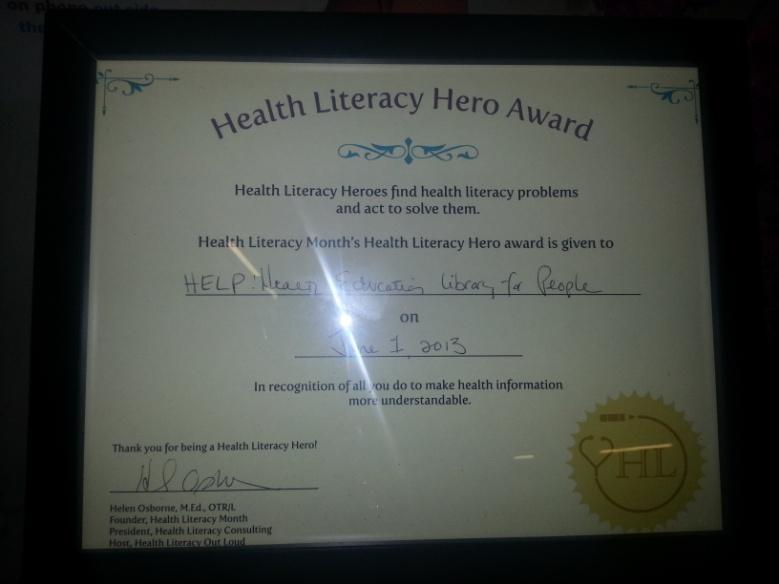
HELP - The Health Literacy Hero for June 2013


We are proud to reproduce an extract from Helen Osborne’s Newsletter:


* 


HL Hero

The Health Literacy Hero for June 2013 is HELP (Health Education Library for People) based in Mumbai, India. Founded as a modest-sized patient education resource center in 1997 by Drs. Aniruddha and Anjali Malpani, HELP is now India's largest patient education center--housing thousands of books, pamphlets,health care magazines, and audiovisuals on all aspects of health and disease.  

HELP offers free public seminars in Mumbai nearly every day. HELP also provides an online resource center where users worldwide can ask health questions and search its vast medical knowledge base. Anjoo Chandiramani and her staff of librarians maintain the HELP collection. Here's the link,  http://www.healthlibrary.com  

HELP is just one of many worldwide efforts to improve health understanding. Please 
email me with your suggestions about other individuals, teams, coalitions, or organizations to honor as Health Literacy Heroes.

Read the complete newsletter at : www.healthliteracy.com


Helen Osborne, M.Ed., OTR/L
Producer & Host of Health Literacy Out Loud

Helen Osborne knows how hard it can be to understand health information. As an occupational therapist, she treated many patients with limited literacy or language skills. As an educator, she is well aware of people’s varied learning needs and styles. And as a patient, Helen knows how very hard it is to listen and remember when feeling scared, sick, or overwhelmed. Now as a health literacy consultant, Helen is working to make a difference.
Helen speaks, writes, and consults about health literacy. She is president of Health Literacy Consulting and founder of Health Literacy Month. Helen presents at conferences across the US and Canada. She also serves as plain language writer and editor on a wide variety of projects. In fact, two of these just won “gold” plain language awards from the National Institute for Health.
Now in her tenth year, Helen is a columnist for the Boston Globe Media’s On Call magazine. She is also author of several books including the award-winning Health Literacy from A-Z. And in keeping with today’s trends and technology, Helen just launched the podcast series, Health Literacy Out Loud.
Whether in-person, in print, or by podcast — Helen lets the world know why health literacy matters!

Subscribe to What's New
*


Wednesday, December 12, 2012

What is Patient Advocacy ?


Patient advocacy

From Wikipedia, the free encyclopedia


Patient advocacy is an area of lay specialization in health care concerned with patient education about the use of health plans and how to obtain needed care. Patient advocates include government consumer advocacy agencies, which provide services to the public at large, and private sector for-profit and non-profit service providers, which offer services to individual patients.

The patient advocate may be an individual or an organization. The terms patient advocate and patient advocacy can refer both to individual advocates providing services that organizations also provide, and to organizations whose functions extend to individual patients. There are also governmental agencies that study and ensure compliance with government regulations including financial aid. Some patient advocates work for the institutions that are directly responsible for the patient’s care.

The patient advocate may provide medical literature and research services to the patient, family, or health care provider. The patient advocate may also assist with family communication on issues arising from illness and injury. This may include further referral for care and support for both patients and families. The patient advocate has a responsibility for awareness of compliance, appropriateness, and coordination of care for the patient, such as oversight for potentially conflicting treatment modalities and medications. The patient advocate can ensure that questions about the appropriateness of treatment are promptly discussed with the patient's care provider, and that all treatments and concerns are promptly entered into the patient's health care record. The patient advocate is also responsible for reviewing the patient's health care record for correctness and explaining it to the patient. Creation and maintenance of an electronic log for the patient that is available on disk to health care providers is another responsibility of the patient advocate, which may be of great benefit in subsequent urgent situations.
The patient advocate can also assist in resolving disputes between patients and their health care provider, as well as engaging in communications on behalf of the patient in the case of employment issues, engaging with the employer to achieve a mutually beneficial solution for the employer and the individual employee. Where applicable compliance standards are not met, the patient advocate may conduct liaison with corporate oversight, government agencies, or legal professionals to further negotiate such issues on behalf of the patient and family.

It is also the duty of the patient advocate to follow any referrals for medical, financial, legal, administrative or other personnel to assure that the patient is always kept safe and well informed, never abandoned or misled during the process.


Saturday, November 17, 2012

Medical Translation Trends in Hind


Medical translation is one of the most difficult forms of translation. A medical translator has to use culturally sensitive language and accurate medical terminology to convey the intended meanings of medical documents. A medical translator needs to make sure that all information, terms, and instructions in the source documents are translated with perfect accuracy, because a minor mistake can have devastating effects on patients and their family members. Medical translation is best performed by someone who has enough medical expertise to ensure accuracy, which is why this is a great opportunity for retired doctors and nurses.

Thanks to globalisation and the rapid dissemination of medical research, medical technology, and medical devices, there has been a significant increase in the demand for medical translators. Along with requiring specialised scientific knowledge, medical translation requires the translator to have superlative language skills. This is because there are a large number of medical terms that are not easy to translate into other languages. Due to the increasing number of new medical terms and novel scientific ideas every year, translating and localising medical contents has become much more complex. Medical translation can cover the entire gamut of the medical field, from the packaging of medicines; to instruction manuals for medical equipment; to medical books.

A medical translator needs to possess outstanding reading and writing skills, so that he or she can fully understand the meaning of the source language; and transmute the information with perfect accuracy and good fluency in the target language. Not only should the translator be able to read and write in both languages, he should be able to think in them as well. It is important to be able to simplify and use an easy-to-understand, conversational style when translating medical documents written for patients.
The most important skill of a good translator is fluency, which allows the translated document to flow smoothly and read well. However, interpretation of flow is very subjective, and there is no simple benchmark by which the standard of translation can be judged. This why the translator must be highly skilled before taking on medical translations. Any translation that is done well will depart from the semantics and structure of the original source language. Grammar is inherently diverse across different languages, and a good translator will retain the meaning of the translation, rather than the original grammatical properties of the source text.

Medical vocabulary is complex, and it cannot be translated well by someone who has only average language skills. The translator should be familiar with the formal writing style used medical books and journal articles, so that the translated documents will look professional. However, the style of writing can vary from one kind of medical document to another. For example, translations of medical marketing materials can be done in a more informal style and tone, whereas a clinical study report must be more structured.

Acronyms and abbreviations are widely used in medicine and these can confuse an inexperienced translator. Thus, BP may stands for blood pressure or bipolar disease; while NVD means either nausea, vomiting and diarrhoea or may also mean normal vaginal delivery. Hence, translating medical terms is tricky and needs expertise and experience. Medical translators are of two kinds - general and specialist. A general medical translator needs to translate documents for the use of a layperson, such as those working in the administration of a hospital, or those giving patients instructions. Such a translator only needs to have basic medical knowledge. A specialist medical translator, on the other hand, translates technical and scientific documents that contain specialised details, such as those found in medical journal articles. He or she must possess an in-depth understanding of the specialisation, including all the medical terms that are used.
Quality assurance is the biggest challenge a medical translator faces. How does one ensure the accuracy of the translated document? The simplest option is to get a skilled assistant to review and edit it. It is also very important to have an end user review the final translation for its readability. Formal protocols for translation and validation have also been developed, which involve forward and back-translation and group-validation to ensure the meaning is not altered as a result of the translation (a process called post hoc conceptual equivalence rating.) For example, a "back-translation" is a translation of a translated text back into the language of the original text, made without reference to the original text. Comparison of a back-translation with the original text is sometimes used as a check of the accuracy of the original translation, much as the accuracy of a mathematical operation is sometimes checked by reversing the operation. But while useful as approximate checks, the results of such reverse operations are not always precisely reliable because words, unlike numbers, are often ambiguous.

What about tools like Google translate? Today there are CAT (Computer-Aided Translation) tools available, which allow translators to facilitate faster, more consistent translations. These include machine translation (MT), machine-aided human translation (MAHT) and interactive translation that use software to translate text from one language to another. On a basic level, MT performs simple substitution of words in one language for words in another, but that alone cannot produce a good translation of a text, because recognition of whole phrases and their closest counterparts in the target language is needed. Solving this problem with statistical techniques is a rapidly growing field that is leading to better translations. Just how good is the output from Google Translate? Well, it depends. Sometimes it is terrible, but other times it is effective. It clearly depends on the subject matter and language pair being used. While Google Translate can be a good tool to assist in translation, it cannot replace a human translator. There are many nuances in languages and translation that a statistical approach or a computer program can't "understand". If you are looking for a quick rough translation, Google Translate is great. For a high level professional translation, at the very least, someone skilled needs to edit the translation.

There are also a number of technical problems that still need to be ironed out. One of the biggest issues with Hindi translation today is the lack of uniformity in the use of a “Hindi (Devanagari) Font". There are dozens of fonts in use, and the lack of standardisation makes life very difficult for the Hindi language translator.

Medical translators serve to bridge the gap between health care providers and patients, which is why they have a pivotal role to play in taking health literacy to the masses. India is a diverse country and we need linguistically proficient and culturally sensitive medical translators who can translate health information materials into local language.


HELP is organizing a conference on “ Putting Patients First Through Health Literacy  “. This will be on Sunday, 2nd December’12 at Nehru Center at 10.30a.m. to 1.p.m.  The website is www.patientpower.in/2012 

The conference will be followed by a free health literacy workshop in the afternoon. Helen Osborne, President, Health Literacy, a world renowned  Consultant from US , will be delivering the keynote and conducting the workshop.  Her website is at www.healthliteracy.com

At this time, we will be releasing the book, Medexplain : Promoting Health Literacy to Put Patients First , authored by Dr Aniruddha Malpani and Juliette Siegfried.

This is Chapter 8 from that book
and has been authored by Dr Mahesh Sharma, @ http://www.ayursharma.com

Tuesday, October 30, 2012

Promoting Health Literacy to Put Patients First - Why health literacy matters !


HELP is organizing a conference on “ Putting Patients First Through Health Literacy". This will be on Sunday, 2nd December’12 at Nehru Center at 10.30a.m. to 1.p.m.  The website is www.patientpower.in/2012 . Registrations are Free !

The conference will be followed by a health literacy workshop in the afternoon. Helen Osborne, President, Health Literacy, a world renowned  Consultant from US , will be delivering the keynote and conducting the workshop.  Her website is at
 www.healthliteracy.com

At this time, we will be releasing the book, Deciphering Medical Gobbledygook: Promoting Health Literacy to Put Patients First , authored by Dr Aniruddha Malpani and Juliette Siegfried.  

This is Chapter 2.

Chap 2. Why should we worry about health literacy?

Imagine that you are in Paris on a holiday. You cannot speak French, and you find you are lost. What do you do? You look for signs in English; check your map; try looking up your guidebook; ask passersby for assistance; and hunt for a policeman to help you find your way back to your hotel. Similarly, when patients fall ill, they find they are lost and helpless in a healthcare system, which seems to be like a foreign country, with its own language and culture. Health literacy can act as their guide and help them to navigate the healthcare system, so they can find their way back to good health!

Health literacy is important at many levels and affects all of us – not just patients and doctors. Health literacy is:

•    an essential life skill for individuals: It helps you to seek and use information and take control over your health.
•    a public health imperative: it improves overall population health.
•    an integral part of social capital: low health literacy is a strong contributor to health inequalities.
•    a critical economic issue: Low health literacy costs the US economy 73 billion dollars per year.

Gone are the “good old days “ when you could depend upon your family doctor to take care of you when you fell ill. Healthcare is changing dramatically, and this change is both a challenge and an opportunity. On the one hand, there is more choice in treatment and more information to guide our choices. On the other hand, there’s little point in having so much information if you cannot make sense of it and the deluge of information is often more confusing than helpful. Health care systems are also becoming more complex , because they involve a wider range of health care professionals from many different specialties, but it often seems that the right hand does not know what the left hand is doing, because of a lack of coordination.

Even though medical science has advanced so much, why aren’t we able to put these advances into practice in real life ? Why is obesity so rampant ? Why do people continue to smoke ? Why do people still die of preventable causes ? Is the problem that people don’t know, don’t want to know, or just don’t care? Perhaps one answer is that they are unable to understand and use the health information available to them. Many people, even educated Indians, don’t know what a calorie is, or how to burn it. It’s our job to make health information meaningful, useful, and helpful.

The rapidly changing health environment demands a lot of us as patients. When we are ill, the decisions we make place us in a vulnerable position in which we must take risks without any certainty of outcome. While health literacy is not a safeguard against this uncertainty, it can help us navigate with a better understanding of potential consequences: and can serve as a map and a compass on a difficult and unpredictable journey.

However, it’s not just enough to just build the health literacy of patients. For our societies to become health literate, all players need to become involved.
 

• Doctors need to tailor their communication to meet the needs of their patients , and see it as their responsibility to foster their health literacy
• Pharmaceutical companies need to educate citizens about their prescriptions . It’s not enough to medicate – they need to educate as well
Health insurance companies need to be transparent and open. Their plans and policies should empower and inform consumers, rather than confuse them with pages of fine print
 
• Politicians need to incorporate health literacy into their design of policy, their research agendas and their objectives for population health.


Unfortunately, health literacy appears to be low worldwide, even in developed countries. According to the World Health Organisation, in the United States, approximately 50% of adults “have difficulties understanding and acting upon health information.” In Australia, 60% of the population scored below a literacy level regarded as optimal for health maintenance.

If patients do not understand their disease or their doctor’s  instructions, they are more likely to skip medical tests; not take their medications on time; and not be able to manage chronic conditions such as high blood pressure or diabetes. The list of problems that can plague patients with low health literacy is long:

•    Delayed diagnosis
•    A higher number of visits to the doctor
•    Increased hospitalisation
•    They are more likely to be taken for a ride by quacks
•    They are more likely to be overcharged, overtested and overtreated

Low health literacy affects all of us. It costs the country hundreds of crores of rupees each year, in terms of unnecessary illnesses, wasted man-hours, and the premature death of productive citizens. People do not know how to prevent diseases such as typhoid and cholera, because they do not understand the basic concepts of hygiene and sanitation. Our high infant mortality rates are a national disgrace – but trying to treat one sick child at a time without addressing the underlying problem of poor health literacy is worse than trying to fix a fracture with a band aid. The biggest tragedy is that all these deaths are preventable, but because the problem of poor health literacy cannot be diagnosed with a blood test, it remains the ignored elephant in the room. Health literacy is an issue of social equality; and we need to develop programs that enable the poor and disadvantaged to make better use of health services. Doctors can act as powerful agents of change. Just providing free drugs will never help unless we first teach citizens how to take care of their own health.


Illiterate patients and clinical trials

India presents an attractive destination for pharmaceutical companies who need to test their drugs on patients by doing clinical trials. India has a large population, with a varied genetic pool. Virtually all Indian doctors speak English, and the infrastructure is easily and inexpensively available, especially in government hospitals. Clinical trials are scientific experiments, and when they are carried out properly, they provide invaluable information. However, illiterate patients are at risk for being exploited in these trials, and misused as guinea pigs.
 

Patients who are unable to read are not able to understand the contents of an informed consent document. Even when the informed consent document is read aloud to them, there is no guarantee that the patient knows what he is signing up for.  Unethical researchers ( who get paid for signing up as many participants as possible) may exaggerate the benefits and compensation , and play down the risks. India’s mind-boggling variety of languages and cultures compounds this problem in that the vast majority of illiterate patients are non-English speakers.
 

The Declaration of Helsinki, which was adopted by the World Medical Association in 1964, states that “each potential subject must be adequately informed of the aims, methods, anticipated benefits and potential risks of the study and the discomfort it may entail, and any other relevant aspects of the study.” While most clinical trials carried out in India today obey the letter of the law, whether they abide by the spirit of getting truly informed consent from the subject is a completely different matter. Even worse, when illiterate test subjects of clinical trials are harmed because of slipshod protocols and inadequate safeguards, they have virtually no recourse, as their access to legal representation is far more limited than for literate patients.
 

To reduce the incidence of improper recruiting and testing of illiterate patients, the Indian government needs to enforce stricter regulation, requiring the presence of disinterested third parties as witnesses for illiterate patients. Informed consent should be routinely recorded on video, and these taped interviews can provide court-admissible evidence of ethical behaviour on the part of the recruiters , in case there are complications , and the pharmaceutical companies which run the clinical trials are accused of wrongdoings. This would help to keep everyone honest and protect the interests of all parties.

How low health literacy affects doctors

Low health literacy makes the doctor’s job more difficult. It is more challenging to work with these patients, because it is difficult to know if they truly understand their condition and will be able to follow the doctor’s instructions. In today’s era of shorter appointments and limited resources, doctors can find dealing with these patients very frustrating , because they are not equipped with the skills to be able to take care of themselves. This is doubly tragic, because this is the group of patients who needs the most help and time from the doctor. 
 

On a deeper level, it makes developing an effective partnership with the patient a greater challenge.  The nature of the doctor-patient relationship has changed significantly, and it is now more important than ever that patients themselves have the ability to navigate and understand healthcare issues relevant to their lives – doctors just do not have the time, energy or resources to be able to spoon-feed them anymore.
 

As patients are expected to be more involved in their care, it becomes increasingly important to ensure that health information can be understood and acted on correctly. Low health literacy is a barrier to good care. Activating patients may help compensate for their lower literacy skills by empowering them to ask questions and expect answers, rather than passively complying with everything the doctor says.

Although patients are far more informed than they were 10 years ago, many express frustration and dissatisfaction with their care because they feel they did not have enough say in the decisions their doctor made for them. One reason is that patients often do not know enough about their treatment options to make well informed decisions. Also, some doctors are not supportive of patient involvement in the decision-making process, because they believe that the doctor knows best. Health literacy plays a key role in obtaining informed consent, communicating health risk, and supporting shared decision-making, thus enhancing patient satisfaction.