Showing posts with label Health Literacy. Show all posts

Tuesday, June 18, 2013

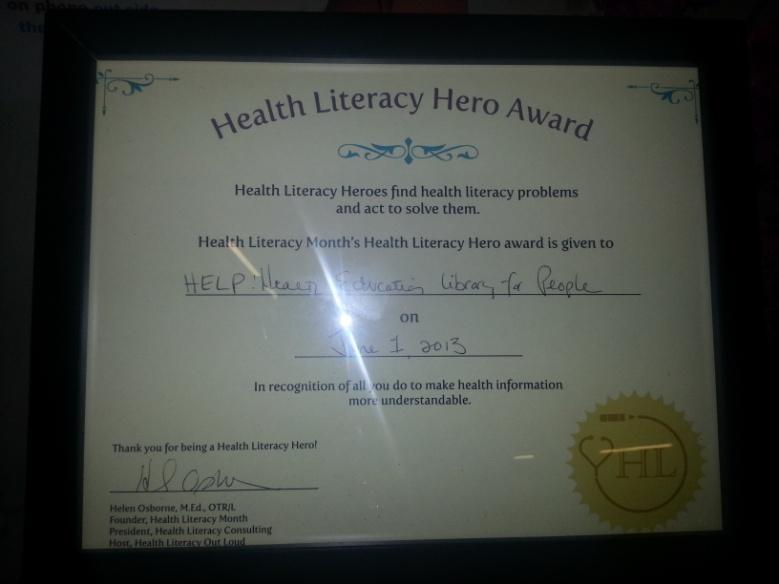
HELP - The Health Literacy Hero for June 2013


We are proud to reproduce an extract from Helen Osborne’s Newsletter:


* 


HL Hero

The Health Literacy Hero for June 2013 is HELP (Health Education Library for People) based in Mumbai, India. Founded as a modest-sized patient education resource center in 1997 by Drs. Aniruddha and Anjali Malpani, HELP is now India's largest patient education center--housing thousands of books, pamphlets,health care magazines, and audiovisuals on all aspects of health and disease.  

HELP offers free public seminars in Mumbai nearly every day. HELP also provides an online resource center where users worldwide can ask health questions and search its vast medical knowledge base. Anjoo Chandiramani and her staff of librarians maintain the HELP collection. Here's the link,  http://www.healthlibrary.com  

HELP is just one of many worldwide efforts to improve health understanding. Please 
email me with your suggestions about other individuals, teams, coalitions, or organizations to honor as Health Literacy Heroes.

Read the complete newsletter at : www.healthliteracy.com


Helen Osborne, M.Ed., OTR/L
Producer & Host of Health Literacy Out Loud

Helen Osborne knows how hard it can be to understand health information. As an occupational therapist, she treated many patients with limited literacy or language skills. As an educator, she is well aware of people’s varied learning needs and styles. And as a patient, Helen knows how very hard it is to listen and remember when feeling scared, sick, or overwhelmed. Now as a health literacy consultant, Helen is working to make a difference.
Helen speaks, writes, and consults about health literacy. She is president of Health Literacy Consulting and founder of Health Literacy Month. Helen presents at conferences across the US and Canada. She also serves as plain language writer and editor on a wide variety of projects. In fact, two of these just won “gold” plain language awards from the National Institute for Health.
Now in her tenth year, Helen is a columnist for the Boston Globe Media’s On Call magazine. She is also author of several books including the award-winning Health Literacy from A-Z. And in keeping with today’s trends and technology, Helen just launched the podcast series, Health Literacy Out Loud.
Whether in-person, in print, or by podcast — Helen lets the world know why health literacy matters!

Subscribe to What's New
*


Wednesday, February 13, 2013

Helping People Learn About Health in India


Aniruddha Malpani MD is a long-time health literacy advocate. He not only is an IVF (fertility) specialist in Mumbai, India but also runs the world’s largest free patient education library, HELP: Health Education Library for People. Dr. Malpani believes that empowered patients can help heal “sick” healthcare systems. In this video, Dr. Malpani talks with Helen Osborne about how this vision is happening in India.
Author: Helen Osborne - Categories: Podcasts
Helen Osborne, M.Ed., OTR/L is the founder and president of Health Literacy Consulting based in Natick, Massachusetts. She is also the producer and host of the podcast series, Health Literacy Out Loud. In addition, Helen is the founder of Health Literacy Month – a worldwide campaign to raise awareness about the importance of understandable health information.

Monday, November 12, 2012

Medexplain: Promoting Health Literacy to Patients First

Free Registrations:  To register please log on to www.patientpower.in


Come to HELP’s conference on “ Putting Patients First Through Health Literacy  “.

This will be on Sunday, 2nd December’12 at Nehru Center at 10.30a.m. to 1.p.m.

The website is www.patientpower.in/2012

The conference will be followed by a health literacy workshop in the afternoon. Helen Osborne, President, Health Literacy, a world renowned  Consultant from US , will be delivering the keynote and conducting the workshop.  Her website is atwww.healthliteracy.com

We will be releasing our book, Decoding Medical Gobbledygook – Health Literacy Puts Patients First, at the conference 

Improving Doctor-Patient Communication by Promoting Health Literacy


When people talk about the need for health literacy training, they often think first about what learners need to do for themselves. However, there is also a pressing need to teach doctors, nurses and medical students how to communicate more effectively with low-literacy patients. It is important for health care providers to speak the language of the patient - after all, there’s little point in making a brilliant diagnosis if the patient ends up not following the doctor’s advise because he did not understand what the doctor said ! Literacy results from an interaction between the reader and the writer and it is not fair to criticize a patient’s reading skills without considering the skills of the author. The mismatch between what people need and what the healthcare system offers is unhealthy and can be deadly. Too often, there exists a chasm of knowledge between what doctors know and what patients understand. Both parties are equally responsible, and to understand why, we need to look at two concepts – the Curse of Knowledge and the ASK Problem.

“The Curse of Knowledge”. The curse of knowledge, otherwise known as the paradox of expertise, is one of the reasons experts have trouble using plain language to communicate their ideas to others who do not share the same expertise. Doctors spend a great deal of time with other doctors, but not enough with patients with limited literacy skills, which means while they speak fluent “medicalese”, they find it hard to talk to patients in plain language.
 

The “ASK” Problem stands for the Anomalous State of Knowledge. This occurs when the patient does not have the knowledge needed to ask the right questions to make a sound decision. In order to ask good questions, we must have a fundamental understanding of the problem at hand. The more complex the information to be processed, the more difficult it is to ask the right questions.
 
To solve these issues, both patients and doctors need training in how to better communicate with each other. For low literate patients, remember that the spoken word is far more important than written communication. Here are some tips for clear verbal communication. None of this is rocket science – it’s simple common sense. Just pretend you were explaining diabetes to your 75-year old grandmother who is hard of hearing.


1. Organize your information.
 
2. Use common words, not technical jargon.
 
3. Give your patients a chance to express how they feel and to tell the story of their illness.
 
4. Make direct eye contact.
 
5. Use written information as a back-up.
 
6. Plan with your patients what they can do.
 
7. Let your patient know what you are thinking.
 
8. Explain procedures and ask permission during examinations.
 
9. Focus on your patient, not on notes, X-rays or the computer screen.
 
10. Check that your patients have understood what you have said.


Translation and Interpretation


It is difficult to achieve seamless communication between patients and doctors, even when they speak the same language. When there are language and cultural barriers, the difficulties are multiplied a hundred-fold. It may seem that an easy solution to the language barrier is to simply translate your pamphlets and materials into local languages. However, because of cultural differences, the materials probably won’t be as useful because there is likely to be a mismatch in values and beliefs. This is what makes translating patient educational materials such a challenging exercise.
 

Before you embark on translating yourself, check to see if there are appropriate materials already available in the languages you need – there is no need to reinvent the wheel. A few excellent websites to check include: Health Information Translations (http://www.healthinfotranslations.org); Ethnomed (http://ethnomed.org); Spiral (http://www.library.tufts.edu/hsl/spiral/index.php) and Healthy Roads Media (http://www.healthyroadsmedia.org). It is shameful that the Indian government has failed to create a suitable library of patient educational materials in regional Indian languages.

If you decide to translate the material yourself, be sure to enlist the help of your patients! Foods, customs, traditions and rituals are often different between cultures and they must be relevant to the reader in order to ensure comprehension. Once translated, materials should be back translated into English to ensure that no changes in meaning or content were introduced.
 

Interpreters can assist both health professionals and patients in improving health literacy, and better outcomes have resulted from the use of competent language services. The main function of the interpreter is to convert a message from one language to another, preserving the original meaning at all times. Many view interpreters as neutral individuals who transmit information back and forth - the "interpreter as a conduit" model. In real life, however, interpreters are often active agents, negotiating between two cultures, and assisting in promoting culturally competent communication. The translation may not be literal and may involve the use of metaphors and ideas that have no direct equivalent in the second language. This role is closer to that of a co-diagnostician, as interpreters decide which medical information is valuable, seek illness-related information independently, and participate in the diagnostic process. A good interpreter serves as much more than just a translator, but also as a cultural bridge between the patient and provider. “As interpreter, my heart is with the patient. I interpret what the patient feels and where he is coming from. But my mind is with the provider – where their knowledge, their wisdom and their scientific values are. (Navajo Interpreter)”

The use of family and friends as interpreters is not always in the best interests of the patient. Unless the situation is an emergency, there may be issues with confidentiality, conflicts of interest, and a lack of familiarity with medical terms. Untrained interpreters may miss, add, or substitute information, and they often do not understand the importance of interpreting everything the patient says. They are likely to include their own thoughts and opinions and impose their own judgments as they speak. For example, if a family member knows someone that was cured of a similar condition using a certain medication, they may be convinced that the same medication will work on this patient. They might not understand that differences between patients can mean significant differences in treatment needs. In addition, it is very difficult to be objective when you are talking about a loved one. Finally, patients themselves may be less likely to be open about confidential or personal information with certain family and friends. When possible, a trained health interpreter is best. If one is not easily available, you can use the help of online interpreters using Skype; and there are also commercial organisations that offer these services through the telephone.

The health issues encountered by immigrants reveal the need for interactive, two-way health literacy efforts. True dialogue can only be achieved if health literacy is perceived as a goal for both the patient and the provider. In the centre column are suggestions for both sides to improve the likelihood of a successful health outcome.

Patient navigation and patient advocacy

In your practice, you may wish to consider using patient navigators or patient advocates, who help low-literate patients with the complex process of managing their health. In 1990, Dr. Freeman established the first Patient Navigation programme at a hospital in Harlem, New York, USA when he noticed that many poor or low-literate patients were either avoiding cancer screening altogether, or not following through on their abnormal test results. The purpose of the programme was to help improve access to cancer screening and ensure proper follow-up among poor patients. After 5 years, results showed that the 5-year survival rate for these cancer patients increased from 39% to 70%! Poor people face many barriers to getting cancer screening and appropriate follow-up. These include: financial constraints; transportation; and bias amongst healthcare staff. Patient navigators are individuals who guide patients with suspicious test results (e.g. possible cancer), through the various complex procedures in cancer care and help ensure they get the right tests and follow-up at the right time. They also assist the patient to receive treatment with respect and compassion.

Patient Advocates (http://www.patientadvocate.org) are similar to patient navigators, but their role is expanded to include help with filling out complex forms, accessing healthcare and disability service, s and negotiating financial issues such as medical debt. They help patients navigate the maze of health insurance throughout their care.
 

Patient advocates come from many health professions including nursing, medicine, and social work. They have the skills needed to assist patients (and their families) with navigating the complex maze of forms, buildings, and people involved in the healthcare system. They use their skills to help patients make the right decisions for themselves.

The most effective patient advocates are trained in low literacy and cultural communication issues and in how to navigate the healthcare systems in their area.


Many hospitals have a Department of Medical Social Work; and medical social workers are trained professionals who can help your poor patients to get the medical care they need, at an affordable rate. Learn to make use of their skills!

Health Coaches

Most doctors tell patients to improve their lifestyle in order to remain healthy. However, no matter how well intentioned your patient maybe, we all know that it’s hard to lose weight; stop smoking; and start exercising. Even if your patients know what they need to do, actually incorporating these changes in their daily behaviour can be very difficult. This is where health coaches come in. A health coach is trained to help people break their goal into manageable steps, nudge them in the right direction, track their progress, and identify and overcome personal roadblocks. Like traditional coaching, health coaches utilize goal setting, identification of obstacles, and use of personal support systems, thus setting up an accountability partnership that is focused on helping people to reach their health goals. Doctors just don’t have enough time to spend with their patients going over nutrition, lifestyle and stress reduction. Health coaches can fill that gap, thus preventing health problems from becoming worse.

Learning from patients
 

Communication is a two-way street, and your task is not only to teach your patients, but to learn from them as well. If you keep your eyes, ears and mind open, you will find that patients have expertise that can be used and shared, if they are systematically involved. You owe it to your patients that they feel respected and treated as people who bring practical experience to the table.

•    Make use of the expertise that your patients bring as learners.
 
•    Respect, involve and appreciate them.
 
•    Recognize that patients can teach health professionals.
 
•    Support organized learners’ groups and activities.


HELP is organizing a conference on “ Putting Patients First Through Health Literacy  “. This will be on Sunday, 2nd December’12 at Nehru Center at 10.30a.m. to 1.p.m.  The website is
 www.patientpower.in/2012 

The conference will be followed by a free health literacy workshop in the afternoon. Helen Osborne, President, Health Literacy, a world renowned  Consultant from US , will be delivering the keynote and conducting the workshop.  Her website is at
 www.healthliteracy.com

At this time, we will be releasing the book, Medexplain : Promoting Health Literacy to Put Patients First , authored by Dr Aniruddha Malpani and Juliette Siegfried. This is Chapter 7 from that book
https://blogger.googleusercontent.com/tracker/10528990-4303625600765242432?l=blog.drmalpani.com

Monday, November 5, 2012

How can I tell if my patient has limited health literacy?


REGISTER NOW: www.patientpower.in

HELP is organizing a conference on “ Putting Patients First ThroughHealth Literacy  “. This will be on Sunday, 2nd December’12 at Nehru Center at 10.30a.m. to 1.p.m.  The website iswww.patientpower.in/2012 . The conference will be followed by ahealth literacy workshop in the afternoon. Helen Osborne, President,Health Literacy, a world renowned  Consultant from US , will be delivering the keynote and conducting the workshop.  Her website is atwww.healthliteracy.com

At this time, we will be releasing the book, Deciphering Medical Gobbledygook: Promoting Health Literacy to Put Patients First , authored by Dr Aniruddha Malpani and Juliette Siegfried.  This is Chapter 4

4 Chap  How can I tell if my patient has limited health literacy ?

While it’s easy to tell if a patient has jaundice, you can’t tell if a patient is health illiterate just by looking. There are many myths about who has limited literacy skills, such as:

•    They have a low IQ and are slow learners
•    They look different from people with high literacy skills
•    Years of schooling correlates with literacy skills
•    They are from ethnic minority populations
•    They will admit that they have limited literacy skills

Doctors often make mistakes when estimating a patient’s health literacy. They may assume poor patients are stupid, or that rich patients understand everything. Both of these stereotypes are incorrect. However, there are clues that can help you know if your patient might need extra help, if you pay attention. For example, if your patients complete their forms incorrectly, or have left many blanks, it may be due to limited literacy skills. Taking medications incorrectly can also be a clue to their lack of understanding of medical terms. Poor communication has many side effects, and your low-literate patients may:

•    Miss appointments frequently
•    Have difficulty complying with treatment or medication instructions
•    Not follow through with tests or referrals to other providers
•    Not read the patient educational materials you provide
•    Forget names of their medications
•    Not be able to explain what a medication is for

Despite these clues, limited health literacy is often a hidden problem. Most people with low literacy skills go undetected by their doctors, because they go to great lengths to hide their literacy problems . They are ashamed and carry a lot of emotional baggage from many years of feeling stupid. This is a very touchy issue for them, and they will often clam up because of humiliation and frustration. Many low-literatepatients are surprisingly smart and have figured out ways to hide their limited literacy skills from others by memorising things they have read before or making intelligent guesses that cleverly camouflage their lack of understanding.

It’s also important to remember that even people with proficient literacy skills can fail to understand complex instructions and health information when they are ill; and many patients avoid asking questions so as not to appear stupid , or because they do not want to annoy a busy physician.


One way to assess whether your patients have adequate health literacy skills is to conduct a “brown bag medication review”. Ask your patients to bring in all the medications they take (both prescription and non-prescription) to their next appointment. Ask the patient to name the medications one by one ; explain what each is for ; and how often they take them. You may suspect low literacy skills if the patient struggles to read the label on the bottle or if they pour out the pills in their hand to look at them. Also, while they may have memorised the dosage instructions, such as, “Take 1 pill every 8 hours”, probing questions such as “When was the last time you took a pill?” may give more clues as to how well they really understand these instructions.

There are several formal assessment tools available for use in the clinic, such as the following:

Newest Vital Sign (available at www.NewestVitalSign.org)

Rapid assessment of health literacy in medicine
(more information at:http://www.rcmar.ucla.edu/rcmar_wiki/Literacy_REALM.html)

While these resources can help you assess your patient’s level of healthliteracy scientifically, their major limitation is that they only give an approximation of reading skills and are incapable of assessing other important aspects of health literacy, such as understanding, motivation and the ability of individuals to access or use information concerninghealth and healthcare.

Universal Precautions

It’s safest to assume that everyone can have difficulty understandinghealth information. Universal Precautions are a method of minimising risk for ALL patients, because you do not know which patients have trouble understanding. The idea is similar to taking universal precautions against the transmission of blood borne infectious diseases when providing medical care , because you do not know which patients are HIV or hepatitis positive.

Many healthcare professionals find it challenging to practice Universal Precautions, because they have to change the way they think and talk to their patients. They also may fear they are “dumbing down” the information , or that patients will be insulted by their use of “ simple language”. However, patient surveys have shown this not to be true. All patients prefer simple and clear communication  and plain language resources provide the means to moving up the ladder of health literacy.

In brief, universal precautions include 4 main areas:

1.    Improving spoken communication
2.    Improving written communication
3.    Improving self-management and empowerment
4.    Improving support systems

Improving spoken communication includes using “plain language” and the “teach-back” technique for clear verbal communication. Improving written communication involves selecting, and creating written materials that patients can understand and make use of easily. Improving self-management and empowerment means increasing self-efficacy and self-care , thus improving adherence to treatment. Improving support systems involves collaborating with professionals and organisations inside and outside the healthcare system to help patients carry out the advice of healthcare professionals. We will address each of these issues individually in this book.

To help healthcare practices implement health literacy universal precautions, The Agency for Healthcare Research and Quality has created a Health Literacy Universal Precautions Toolkit (http://www.nchealthliteracy.org/toolkit/) for health professionals. This provides step-by-step instructions for healthcare practices and offers a systematic approach to simplifying medical care and helping patients get the right medical care.

For there to be a solution, the problem must be recognized. This is not an easy task  because illiterate patients are masters at hiding their inability to read – after all, this isn’t something that they want to be advertised. With all of our progress and technology, people are still slipping through the school system unable to read. The educational system has failed them; does the health care system have to as well?

Saturday, November 3, 2012

How can I tell if my patient has limited health literacy?


HELP is organizing a conference on “ Putting Patients First Through Health Literacy  “. This will be on Sunday, 2nd December’12 at Nehru Center at 10.30a.m. to 1.p.m.  The website iswww.patientpower.in/2012 . The conference will be followed by a health literacy workshop in the afternoon. Helen Osborne, President, Health Literacy, a world renowned  Consultant from US , will be delivering the keynote and conducting the workshop.  Her website is atwww.healthliteracy.com

At this time, we will be releasing the book, Deciphering Medical Gobbledygook: Promoting Health Literacy to Put Patients First , authored by Dr Aniruddha Malpani and Juliette Siegfried.  This is Chapter 4
4 Chap  How can I tell if my patient has limited health literacy ?
While it’s easy to tell if a patient has jaundice, you can’t tell if a patient is health illiterate just by looking. There are many myths about who has limited literacy skills, such as:
•    They have a low IQ and are slow learners •    They look different from people with high literacy skills •    Years of schooling correlates with literacy skills •    They are from ethnic minority populations •    They will admit that they have limited literacy skills
Doctors often make mistakes when estimating a patient’s health literacy. They may assume poor patients are stupid, or that rich patients understand everything. Both of these stereotypes are incorrect. However, there are clues that can help you know if your patient might need extra help, if you pay attention. For example, if your patients complete their forms incorrectly, or have left many blanks, it may be due to limited literacy skills. Taking medications incorrectly can also be a clue to their lack of understanding of medical terms. Poor communication has many side effects, and your low-literate patients may:
•    Miss appointments frequently •    Have difficulty complying with treatment or medication instructions •    Not follow through with tests or referrals to other providers •    Not read the patient educational materials you provide  •    Forget names of their medications  •    Not be able to explain what a medication is for
Despite these clues, limited health literacy is often a hidden problem. Most people with low literacy skills go undetected by their doctors, because they go to great lengths to hide their literacy problems . They are ashamed and carry a lot of emotional baggage from many years of feeling stupid. This is a very touchy issue for them, and they will often clam up because of humiliation and frustration. Many low-literate patients are surprisingly smart and have figured out ways to hide their limited literacy skills from others by memorising things they have read before or making intelligent guesses that cleverly camouflage their lack of understanding. 
It’s also important to remember that even people with proficient literacy skills can fail to understand complex instructions and health information when they are ill; and many patients avoid asking questions so as not to appear stupid , or because they do not want to annoy a busy physician. 
One way to assess whether your patients have adequate health literacy skills is to conduct a “brown bag medication review”. Ask your patients to bring in all the medications they take (both prescription and non-prescription) to their next appointment. Ask the patient to name the medications one by one ; explain what each is for ; and how often they take them. You may suspect low literacy skills if the patient struggles to read the label on the bottle or if they pour out the pills in their hand to look at them. Also, while they may have memorised the dosage instructions, such as, “Take 1 pill every 8 hours”, probing questions such as “When was the last time you took a pill?” may give more clues as to how well they really understand these instructions. 
There are several formal assessment tools available for use in the clinic, such as the following:
Newest Vital Sign (available at www.NewestVitalSign.org)
Rapid assessment of health literacy in medicine  (more information at:http://www.rcmar.ucla.edu/rcmar_wiki/Literacy_REALM.html)
While these resources can help you assess your patient’s level of health literacy scientifically, their major limitation is that they only give an approximation of reading skills and are incapable of assessing other important aspects of health literacy, such as understanding, motivation and the ability of individuals to access or use information concerning health and healthcare.
Universal Precautions
It’s safest to assume that everyone can have difficulty understanding health information. Universal Precautions are a method of minimising risk for ALL patients, because you do not know which patients have trouble understanding. The idea is similar to taking universal precautions against the transmission of blood borne infectious diseases when providing medical care , because you do not know which patients are HIV or hepatitis positive.
Many healthcare professionals find it challenging to practice Universal Precautions, because they have to change the way they think and talk to their patients. They also may fear they are “dumbing down” the information , or that patients will be insulted by their use of “ simple language”. However, patient surveys have shown this not to be true. All patients prefer simple and clear communication  and plain language resources provide the means to moving up the ladder of health literacy.
In brief, universal precautions include 4 main areas:
1.    Improving spoken communication 2.    Improving written communication 3.    Improving self-management and empowerment 4.    Improving support systems
Improving spoken communication includes using “plain language” and the “teach-back” technique for clear verbal communication. Improving written communication involves selecting, and creating written materials that patients can understand and make use of easily. Improving self-management and empowerment means increasing self-efficacy and self-care , thus improving adherence to treatment. Improving support systems involves collaborating with professionals and organisations inside and outside the healthcare system to help patients carry out the advice of healthcare professionals. We will address each of these issues individually in this book.
To help healthcare practices implement health literacy universal precautions, The Agency for Healthcare Research and Quality has created a Health Literacy Universal Precautions Toolkit (http://www.nchealthliteracy.org/toolkit/) for health professionals. This provides step-by-step instructions for healthcare practices and offers a systematic approach to simplifying medical care and helping patients get the right medical care. 
For there to be a solution, the problem must be recognized. This is not an easy task  because illiterate patients are masters at hiding their inability to read – after all, this isn’t something that they want to be advertised. With all of our progress and technology, people are still slipping through the school system unable to read. The educational system has failed them; does the health care system have to as well?

Why we need to tackle the problem of health literacy urgently


HELP is organizing a conference on “ Putting Patients First Through Health Literacy  “. This will be on Sunday, 2nd December’12 at Nehru Center at 10.30a.m. to 1.p.m.  The website iswww.patientpower.in/2012 

The conference will be followed by a health literacy workshop in the afternoon. Helen Osborne, President, Health Literacy, a world renowned  Consultant from US , will be delivering the keynote and conducting the workshop.  Her website is at www.healthliteracy.com

At this time, we will be releasing the book, Deciphering Medical Gobbledygook: Promoting Health Literacy to Put Patients First , authored by Dr Aniruddha Malpani and Juliette Siegfried.

This is Chapter 3.

3. Why we need to tackle the problem of health literacy urgently


In the past, doctors had access to specialised medical knowledge that was denied to a patient. Patients used to be very impressed with the depth of the doctor’s clinical acumen, and were pleased when he made the right diagnosis and provided the correct treatment. Today, however, thanks to the internet, patients have access to a world of health information that was previously only accessible in medical schools and specialised libraries.

This change can be both a blessing and a curse. Due to the easy accessibility of the information and the limited availability of doctors, many people now rely on the Internet for their health information instead of their doctor. However, the available information is usually complex and may be difficult to understand. Because medicine is an art, there is not usually one clear answer to address a particular health issue and the choice of treatment depends on many factors related to both the disease and the patient’s preferences. Doctors now have to work with patients, so they can understand all the options available to them, and come up with a treatment plan in which both the doctor and the patient are invested. If not, non-compliance with treatment is a serious risk.

Patients now have more responsibility than ever before to take part in their healthcare, and for patients with limited health literacy, this responsibility can be overwhelming and frustrating.  While there is a lot of information on the Internet, a lot of this information is wrong, unreliable and out-dated. Many patients are not sophisticated enough to separate the wheat from the chaff and are easily exploited by quacks. Freely accessible Internet health forums offer hundreds of explanations and treatments for illnesses , but many of these are incorrect. However, naïve readers may not even consult their doctor before following the advice of someone they have never met , just because she seems to share their symptoms, or understands their concerns. Following the advice may or may not be appropriate, and can be quite dangerous if it involves the use of medications – medications that can easily be bought online at the click of a mouse, without a prescription.

Health professionals often feel frustrated when dealing with illiterate patients because they do not know how best to help them. The reasons for this are many:

•    The medical and nursing education curricula are already crowded and doctors are not taught how to communicate with illiterate patients
•    Low health literacy is not be considered to be a priority issue
•    The doctor has only 15 minutes to talk to the patient, and this is simply not enough to ensure  clear communication

Patients now live an average of 10 years longer than they did in 1948. Older patients have more chronic medical conditions, which can often be managed for many years thanks to modern technology. However, medical management may require multiple medicines, an army of specialists, continuous monitoring of progress and side effects, and adherence to complex treatment regimens.  Older patients are particularly badly hit by poor health literacy. This is a double whammy for them, because even though the complexity of their medical problems increases exponentially as they age, their reading and comprehension abilities decline because of a progressive loss of vision, hearing and cognitive skills. This means that even if they were able to cope when they were younger, they have a much harder time as they age – and this can prove to be a huge burden on themselves, their caregivers and their doctors. The greying of developed countries means that the magnitude of these problems will soon become unmanageable.

As our life styles progressively deteriorate thanks to urbanization, the burden of chronic diseases and lifestyle illnesses (such as diabetes, heart disease and obesity) will increase exponentially. When a person with low health literacy has a chronic disease, serious barriers to self-care can arise.

People living with chronic disease usually have more than one condition and may have a complex care plan, involving multiple medications and multiple healthcare providers, many of whom have no idea what the other is doing. There is usually no coordination of care; and patients may receive inconsistent messages from different doctors as they make their way through the system, leaving them even more confused.

Getting the right treatment and keeping track of medications and appointments is difficult, even for highly educated patients, so you can just imagine the plight of illiterate patients. What chance do they have of being able to cope? Many will fall in between the cracks, but the bigger tragedy is that rather than fix the system, we will blame them for not seeking medical care at the right time!

Most patients living with chronic diseases are expected to manage their own care, under the supervision of their doctor. This includes using monitoring devices such as glucometers, and knowing how to modify their medication, diet , exercise or other behaviours based on the results. However, in spite of this complexity, patients have limited time with their doctor. For example, a typical physician visit to monitor diabetes takes place every 3 months unless there are serious complications and this visit typically lasts about 15 minutes. In that time, the provider must carry out an assessment, order any tests required, answer questions and provide instruction for self-care. Under the best of circumstances, this can be challenging for both the provider and the patient. To be able to expect patients with low literacy to learn everything they need to in these 15 minutes is a tall order.

Time is an important factor in building trust and collaboration between doctor and patient. For adults with literacy barriers, new skills for self-management are best learned through listening to explanations, watching demonstrations, asking questions, clarifying doubts and practicing over repeated visits. Limited time for direct contact gets in the way of this learning process.


Health news in the media

One would have hoped that easy access to information from the media would help to alleviate some of these problems and that patients would be able to obtain reliable information from sources other than their doctors. However, modern trends in mass media have just exacerbated the problem of poor health literacy. Gary Schwitzer of Health News Review examined over 1600 health stories over 5 years and found several recurring problems in them:

1.    News stories, press releases and commercials are often misleading because they exaggerate the benefits of interventions and minimise the harms. For example, you read an article that claims that a new drug reduces the risk of a heart attack by 50%. Your loving wife promptly takes you to the doctor and pressures him into prescribing the drug for you. However, the article does not explain that the 50% refers to a relative risk, rather than an absolute risk. Relative risk means that there was be a reduction from 2 heart attacks in 100 untreated patients to 1 heart attack in treated patients. This is only a 1% absolute risk reduction. This means that the 99 remaining patients had to spend money on buying the drug and risk getting its side effects, without getting any benefit whatsoever. These are not easy concepts to explain to anyone, much less to low-literate people.
2.    News stories seem to equate “association” with “causation”. There may be an association between A and B, but this does not mean that A causes B. For example, NBC news once reported that eating chocolate may decrease heart disease by as much as 37%, and MSNBC reported that drinking coffee may protect against breast cancer. What’s worse is that later stories contradict the earlier ones, leading to confusion and scepticism among viewers.
3.    The third problem was the promotion and overuse of “screening” tests, which are used to test people with no symptoms for a disease. These are often heavily promoted for everyone, which leads to unnecessary testing, anxiety, and even harm due to the tests themselves.

This means that rather than help doctors dispel myths and misconceptions, the media often makes a bad situation worse by misinforming patients, as a result of commercial marketing pressures. Health literacy can help a reader to separate the wheat from the chaff; and not get misled.

Tuesday, October 30, 2012

Promoting Health Literacy to Put Patients First - Why health literacy matters !


HELP is organizing a conference on “ Putting Patients First Through Health Literacy". This will be on Sunday, 2nd December’12 at Nehru Center at 10.30a.m. to 1.p.m.  The website is www.patientpower.in/2012 . Registrations are Free !

The conference will be followed by a health literacy workshop in the afternoon. Helen Osborne, President, Health Literacy, a world renowned  Consultant from US , will be delivering the keynote and conducting the workshop.  Her website is at
 www.healthliteracy.com

At this time, we will be releasing the book, Deciphering Medical Gobbledygook: Promoting Health Literacy to Put Patients First , authored by Dr Aniruddha Malpani and Juliette Siegfried.  

This is Chapter 2.

Chap 2. Why should we worry about health literacy?

Imagine that you are in Paris on a holiday. You cannot speak French, and you find you are lost. What do you do? You look for signs in English; check your map; try looking up your guidebook; ask passersby for assistance; and hunt for a policeman to help you find your way back to your hotel. Similarly, when patients fall ill, they find they are lost and helpless in a healthcare system, which seems to be like a foreign country, with its own language and culture. Health literacy can act as their guide and help them to navigate the healthcare system, so they can find their way back to good health!

Health literacy is important at many levels and affects all of us – not just patients and doctors. Health literacy is:

•    an essential life skill for individuals: It helps you to seek and use information and take control over your health.
•    a public health imperative: it improves overall population health.
•    an integral part of social capital: low health literacy is a strong contributor to health inequalities.
•    a critical economic issue: Low health literacy costs the US economy 73 billion dollars per year.

Gone are the “good old days “ when you could depend upon your family doctor to take care of you when you fell ill. Healthcare is changing dramatically, and this change is both a challenge and an opportunity. On the one hand, there is more choice in treatment and more information to guide our choices. On the other hand, there’s little point in having so much information if you cannot make sense of it and the deluge of information is often more confusing than helpful. Health care systems are also becoming more complex , because they involve a wider range of health care professionals from many different specialties, but it often seems that the right hand does not know what the left hand is doing, because of a lack of coordination.

Even though medical science has advanced so much, why aren’t we able to put these advances into practice in real life ? Why is obesity so rampant ? Why do people continue to smoke ? Why do people still die of preventable causes ? Is the problem that people don’t know, don’t want to know, or just don’t care? Perhaps one answer is that they are unable to understand and use the health information available to them. Many people, even educated Indians, don’t know what a calorie is, or how to burn it. It’s our job to make health information meaningful, useful, and helpful.

The rapidly changing health environment demands a lot of us as patients. When we are ill, the decisions we make place us in a vulnerable position in which we must take risks without any certainty of outcome. While health literacy is not a safeguard against this uncertainty, it can help us navigate with a better understanding of potential consequences: and can serve as a map and a compass on a difficult and unpredictable journey.

However, it’s not just enough to just build the health literacy of patients. For our societies to become health literate, all players need to become involved.
 

• Doctors need to tailor their communication to meet the needs of their patients , and see it as their responsibility to foster their health literacy
• Pharmaceutical companies need to educate citizens about their prescriptions . It’s not enough to medicate – they need to educate as well
Health insurance companies need to be transparent and open. Their plans and policies should empower and inform consumers, rather than confuse them with pages of fine print
 
• Politicians need to incorporate health literacy into their design of policy, their research agendas and their objectives for population health.


Unfortunately, health literacy appears to be low worldwide, even in developed countries. According to the World Health Organisation, in the United States, approximately 50% of adults “have difficulties understanding and acting upon health information.” In Australia, 60% of the population scored below a literacy level regarded as optimal for health maintenance.

If patients do not understand their disease or their doctor’s  instructions, they are more likely to skip medical tests; not take their medications on time; and not be able to manage chronic conditions such as high blood pressure or diabetes. The list of problems that can plague patients with low health literacy is long:

•    Delayed diagnosis
•    A higher number of visits to the doctor
•    Increased hospitalisation
•    They are more likely to be taken for a ride by quacks
•    They are more likely to be overcharged, overtested and overtreated

Low health literacy affects all of us. It costs the country hundreds of crores of rupees each year, in terms of unnecessary illnesses, wasted man-hours, and the premature death of productive citizens. People do not know how to prevent diseases such as typhoid and cholera, because they do not understand the basic concepts of hygiene and sanitation. Our high infant mortality rates are a national disgrace – but trying to treat one sick child at a time without addressing the underlying problem of poor health literacy is worse than trying to fix a fracture with a band aid. The biggest tragedy is that all these deaths are preventable, but because the problem of poor health literacy cannot be diagnosed with a blood test, it remains the ignored elephant in the room. Health literacy is an issue of social equality; and we need to develop programs that enable the poor and disadvantaged to make better use of health services. Doctors can act as powerful agents of change. Just providing free drugs will never help unless we first teach citizens how to take care of their own health.


Illiterate patients and clinical trials

India presents an attractive destination for pharmaceutical companies who need to test their drugs on patients by doing clinical trials. India has a large population, with a varied genetic pool. Virtually all Indian doctors speak English, and the infrastructure is easily and inexpensively available, especially in government hospitals. Clinical trials are scientific experiments, and when they are carried out properly, they provide invaluable information. However, illiterate patients are at risk for being exploited in these trials, and misused as guinea pigs.
 

Patients who are unable to read are not able to understand the contents of an informed consent document. Even when the informed consent document is read aloud to them, there is no guarantee that the patient knows what he is signing up for.  Unethical researchers ( who get paid for signing up as many participants as possible) may exaggerate the benefits and compensation , and play down the risks. India’s mind-boggling variety of languages and cultures compounds this problem in that the vast majority of illiterate patients are non-English speakers.
 

The Declaration of Helsinki, which was adopted by the World Medical Association in 1964, states that “each potential subject must be adequately informed of the aims, methods, anticipated benefits and potential risks of the study and the discomfort it may entail, and any other relevant aspects of the study.” While most clinical trials carried out in India today obey the letter of the law, whether they abide by the spirit of getting truly informed consent from the subject is a completely different matter. Even worse, when illiterate test subjects of clinical trials are harmed because of slipshod protocols and inadequate safeguards, they have virtually no recourse, as their access to legal representation is far more limited than for literate patients.
 

To reduce the incidence of improper recruiting and testing of illiterate patients, the Indian government needs to enforce stricter regulation, requiring the presence of disinterested third parties as witnesses for illiterate patients. Informed consent should be routinely recorded on video, and these taped interviews can provide court-admissible evidence of ethical behaviour on the part of the recruiters , in case there are complications , and the pharmaceutical companies which run the clinical trials are accused of wrongdoings. This would help to keep everyone honest and protect the interests of all parties.

How low health literacy affects doctors

Low health literacy makes the doctor’s job more difficult. It is more challenging to work with these patients, because it is difficult to know if they truly understand their condition and will be able to follow the doctor’s instructions. In today’s era of shorter appointments and limited resources, doctors can find dealing with these patients very frustrating , because they are not equipped with the skills to be able to take care of themselves. This is doubly tragic, because this is the group of patients who needs the most help and time from the doctor. 
 

On a deeper level, it makes developing an effective partnership with the patient a greater challenge.  The nature of the doctor-patient relationship has changed significantly, and it is now more important than ever that patients themselves have the ability to navigate and understand healthcare issues relevant to their lives – doctors just do not have the time, energy or resources to be able to spoon-feed them anymore.
 

As patients are expected to be more involved in their care, it becomes increasingly important to ensure that health information can be understood and acted on correctly. Low health literacy is a barrier to good care. Activating patients may help compensate for their lower literacy skills by empowering them to ask questions and expect answers, rather than passively complying with everything the doctor says.

Although patients are far more informed than they were 10 years ago, many express frustration and dissatisfaction with their care because they feel they did not have enough say in the decisions their doctor made for them. One reason is that patients often do not know enough about their treatment options to make well informed decisions. Also, some doctors are not supportive of patient involvement in the decision-making process, because they believe that the doctor knows best. Health literacy plays a key role in obtaining informed consent, communicating health risk, and supporting shared decision-making, thus enhancing patient satisfaction.